
The Stick’AIR macaron (also written StickAir or Stick Air) is an air quality sticker used in Geneva to limit driving during episodes of high air pollution. The cantonal rules have applied since January 15, 2020. So far the scheme has been activated twice: for fine particles in January 2020, with driving restrictions from January 23 to 27, and for ozone on August 13, 2025. Outside these episodes, the sticker has no effect in Geneva and you can drive as usual. The sticker costs CHF 5, goes on your windshield and sorts your vehicle into one of six categories (0 to 5) according to its emissions standard. The lower the number, the cleaner the vehicle.
If you own or plan to buy a car in Geneva, I recommend getting the sticker when you register it. It is cheap, it stays valid for the life of the vehicle, and without it you are among the first to be banned when an alert starts.
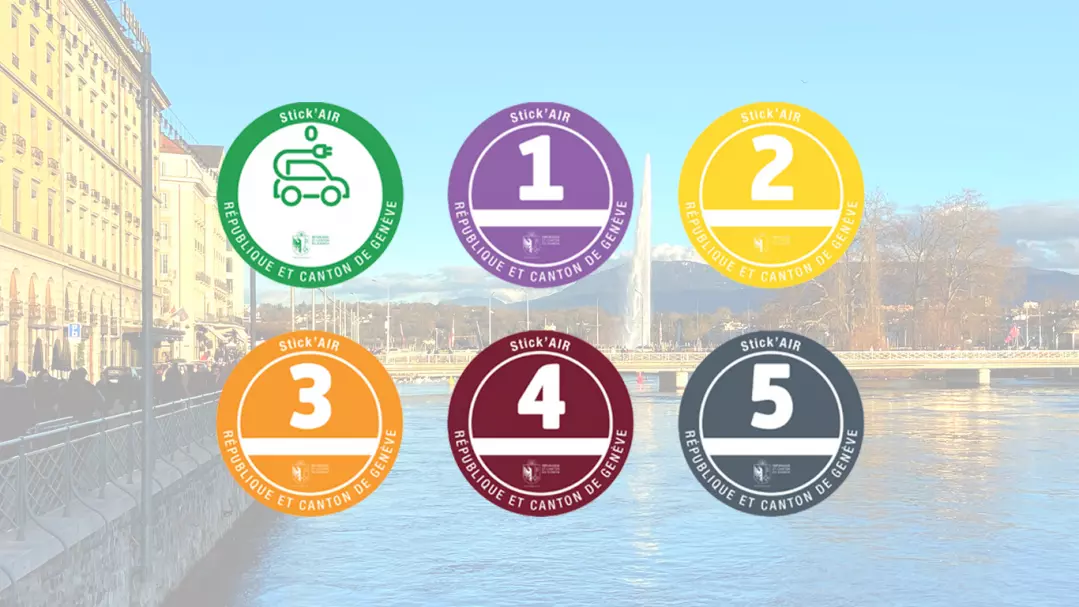
Photo credits: ACS Section Genève
When the Stick’AIR is required
In Geneva, the sticker only matters when the canton activates the scheme because of a pollution peak (fine particles, ozone or nitrogen dioxide). The restrictions then apply only between 6 a.m. and 10 p.m., and only inside a perimeter in the center of the canton: almost all of the City of Geneva and part of Carouge, Cologny, Lancy and Vernier. Outside that perimeter, and outside an alert, there is no restriction.
Geneva does not have a permanent low-emission zone. The canton switches the scheme on only during pollution episodes, unlike permanent zones such as the one in Annemasse in France, described below.
All motor vehicles are covered, whatever the driver’s status and wherever the vehicle is registered, including other cantons and abroad, unless they appear in the exemption list further down.
The three alert levels
The canton escalates in three steps (“paliers”). Each level adds to the previous one. The first level is triggered by a forecast, so the ban can start before the alert threshold is actually measured.
| Level | Banned from the perimeter | Also applies |
|---|---|---|
| 1 of 3, preventive (“activation”) | Vehicles with sticker 5, and vehicles with no sticker | Speed limit of 80 km/h on the A1 highway around Geneva (the “autoroute de contournement”, which runs west of the city past the airport) |
| 2 of 3, reinforced (“alerte”) | Everything from level 1, plus sticker 4 | Free public transportation anywhere in the canton (Unireso fare zone 10) from the day after the announcement |
| 3 of 3, extended (“urgence”) | Everything from level 2, plus sticker 3 | Free public transportation continues. During fine-particle (PM10) peaks, outdoor fires and wood fires lit for comfort, such as in fireplaces and stoves, are banned |
So at level 2, only vehicles with sticker 0, 1, 2 or 3 may enter the perimeter. That is what applied during the ozone episode of August 2025. The January 2020 episode stayed at level 1, so stickers 0 to 4 could still drive.
How to find your category
For a vehicle registered in Switzerland, the category follows from the fuel type and box 72 (“Code émissions”) of your vehicle registration document (permis de circulation). For a vehicle registered in the European Union, it follows from the vehicle type, fuel type and Euro emissions standard shown on its registration certificate. Choosing the right category is the owner’s responsibility, so bring your registration document when you buy the sticker and ask the seller to confirm it.
If you imported a car and box 72 of its Swiss registration document does not reflect its real emissions standard, ask the cantonal vehicle office to correct it. For a car from Europe, the document to provide is the European certificate of conformity. For a car from outside Europe, you bring the car to the inspection hall of the cantonal vehicle office during opening hours. A vehicle too old for any category gets no sticker and is banned as soon as level 1 starts. Vehicles driven on a garage’s or dealer’s professional plates (marked “U”), which have no registration document of their own, must carry a sticker chosen from their technical documents.
Is the French Crit’Air sticker accepted in Geneva?
France’s Crit’Air sticker is recognized in Geneva with the same numbering, so if you live in France and drive into Geneva, your Crit’Air counts. Pollution stickers from other countries are not recognized. It works the other way too: France has a permanent low-emission zone (ZFE-m) in and around Annemasse, where a Stick’AIR counts like a Crit’Air. Since January 1, 2025, vehicles with neither sticker may not drive in that zone, and stricter steps are planned. If you are still deciding whether to import or register a car, see How to import a vehicle and How to register your vehicle and get Swiss license plates.
How to get the Stick’AIR and what it costs
The sticker costs CHF 5, which the canton says covers its production and distribution. You can get it:
- online, through the canton’s portal, where you determine your category and order it. Shipping and processing fees apply. Delivery usually takes 10 to 15 days, and the payment receipt sent by email serves as temporary proof for up to 30 days if your vehicle is checked;
- in person at the cantonal vehicle office (Office cantonal des véhicules, route de Veyrier 86, Carouge) or at the Fondation des parkings, Geneva’s public parking foundation (Carrefour de l’Etoile 1, Carouge). Check the opening hours on the canton’s page before you go;
- at participating garages, body shops and gas stations in the canton.
Correctly stuck, the sticker stays valid for the whole life of the vehicle. A sticker that has come off the windshield is no longer valid. If you bought the wrong one, the vehicle office exchanges it only if it is still on its backing sheet and in perfect condition. For vehicles without a windshield, such as some motorcycles, three-wheelers and quadricycles, the sticker goes on an easily reached part of the vehicle that cannot be swapped.
What it costs if you ignore it
Driving into the perimeter during an alert without an authorized sticker is a minor offense, with a fine of up to CHF 500 under article 15 of the cantonal regulation. In 2020 the fine was provisionally suspended while the scheme was challenged in court; since November 2020 it applies in full.
Bulletins, alerts, and free public transportation
When restrictions are activated, the canton publishes a bulletin, which can be checked on the official cantonal website, Air2G2 air quality website and apps. You can also subscribe to the canton’s free email alert, sent the day before measures start, or turn on notifications in the Air2G2 app.
At level 2 or 3, from the start of service on the day after the announcement, anyone can use public transportation anywhere in the canton without a ticket. The free area is Unireso fare zone 10 (Unireso is Geneva’s public transportation fare network). It ends after the last night service on the day the canton announces the end of the episode. Tickets are still checked in other fare zones, ticket machines keep selling, and there is no refund for existing passes. At level 1, you still pay for public transportation. For passes and the rest of the network, see Transportation and parking.
Which vehicles are exempt
The regulation (article 5) exempts these vehicles from the sticker obligation:
- police and other emergency vehicles with flashing blue lights;
- vehicles displaying a disabled parking permit;
- agricultural vehicles, military vehicles (M plates on a black background) and special convoys (oversize loads);
- vehicles used to carry passengers for a living, including taxis (for Geneva registrations, recognizable by GE 96 plates);
- consular and diplomatic vehicles (CC and CD plates);
- work vehicles on blue plates, such as street sweepers, snowplows and excavators;
- funeral vehicles carrying deceased persons;
- bicycles and mopeds, including electric bikes.
Vehicles that carry goods, such as delivery vans and trucks, had a transition period until January 15, 2022 and are now covered like everyone else.
Exemptions for diplomatic and consular vehicles (CD and CC)
Vehicles registered with diplomatic (CD) or consular (CC) plates are exempt from the obligation to display a Stick’AIR sticker. This exemption applies regardless of the vehicle’s emissions category. For buying or selling such cars, see Diplomatic car sales in Switzerland explained.
Key French words in this article
Terms you will see during pollution alerts.
- le Stick’AIR
- the Stick’AIR sticker
- un macaron
- a sticker
- la pollution de l’air
- air pollution
- un pic de pollution
- a pollution peak
- la circulation différenciée
- restricted traffic
- un palier
- an alert level
- un véhicule
- a vehicle
- une exception
- an exemption
- le permis de circulation
- the vehicle registration document
- une amende
- a fine
- les transports publics gratuits
- free public transportation
Want to use these words with your own documents? I teach French one to one online, and the first 30 minutes are free. More information: privatefrenchgeneva.ch
Ask Samuel
Stuck on something in this article?
Send me your question and get a quick answer for CHF 50, usually within 2 hours during working hours.
Working hours are Monday to Friday, 9am to 7pm Geneva time, and I reply within one business day at most. Weekends are for urgent matters.