
To send a letter in Switzerland, put it in a C5 envelope, write the address along the long side, put a stamp in the top-right corner and drop it in a yellow Swiss Post mailbox. A standard letter costs about CHF 1 to 2 as A Mail, delivered the next working day, or about CHF 1 to 1.50 as B Mail, delivered within three working days. Swiss Post raises its letter prices slightly on January 1, 2027, and the standard weight limit then drops from 100 g to 50 g.
Last checked: November 2026. Sources: Swiss Post’s price, addressing and letter design pages and its August 2026 announcement of the 2027 prices. Swiss Post changes its prices and rules from time to time, so use its price calculator before you send something important.
Physical mail is still needed in Switzerland for many procedures: signed letters (such as the templates in my toolkit), contracts, official forms, credit card applications and more.
How much does it cost to send a letter in Switzerland?
| Service | Price | Delivery |
|---|---|---|
| A Mail (the priority service), standard letter | About CHF 1 to 2 | Next working day, Monday to Saturday |
| B Mail (the economy service), standard letter | About CHF 1 to 1.50 | Within three working days, not on Saturdays |
| Registered mail (“Einschreiben”) | About CHF 5 to 8 | Next working day, Monday to Friday, against signature |
Heavier or bulkier letters cost more:
- A midi letter costs about CHF 1 to 2. Until the end of 2026 it is a letter of 101 to 500 g.
- A large letter, up to 35.3 × 25 cm (format B4) and 1 kg, costs about CHF 2 to 3.
- A letter between 2 and 5 cm thick costs extra: a few francs more. From 2027, Swiss Post introduces a “volume letter” (“Volumenbrief”) for bulky contents, which costs about CHF 4 to 5 in total and includes tracking.
- Anything over 1 kg or over 5 cm thick has to go as a parcel.
Because the standard weight limit drops from 100 g to 50 g in 2027, a letter of 51 to 100 g will then be priced as a midi letter. The prices of the heavier formats may change in 2027 too, so check the official Swiss Post price calculator for the format you need. Stamps you already own stay valid, but you will need supplementary stamps for the difference from January 1, 2027, according to a Swiss Post spokesperson quoted by the newspaper Blick in August 2026.
Which envelope should I use?
A C5 envelope (22.9 × 16.2 cm) is the most practical choice. An A4 sheet folded in half fits in it, and it stays within the standard letter size. A window envelope works too, as long as the address shows through the window. Keep the envelope thin: above 2 cm, you pay the surcharge above.
How to address a letter in Switzerland
Swiss Post asks for three to six lines, written along the long side of the envelope:
- The recipient’s name, with a title such as “Monsieur” or “Madame” if you like.
- The official street name and the house number.
- The four-digit postal code (“NPA”) and the full name of the town, not underlined.
For example:
Monsieur Jean Dupont
Rue de la Mairie 5
1207 Genève
For a P.O. box (“case postale” in French, “Postfach” in German), write it on the second-to-last line, above the postal code and town. Where you put things on the envelope matters, because Swiss Post sorts letters by machine:
- Write the address in the reading zone, below the stamp corner and above the bottom strip, either on the right or on the left of the envelope. Do not draw a frame around it.
- Leave the top-right corner free for the stamp, about 7.4 × 3.8 cm.
- Keep the bottom strip of about 1.5 cm empty, because Swiss Post’s sorting machines need it.
- Write your own address (name, street or P.O. box, postal code and town) above the recipient’s address, usually in the top-left corner, or on the back. If the letter cannot be delivered, it comes back to you. The photo below shows this layout, with a registered label in the stamp corner.
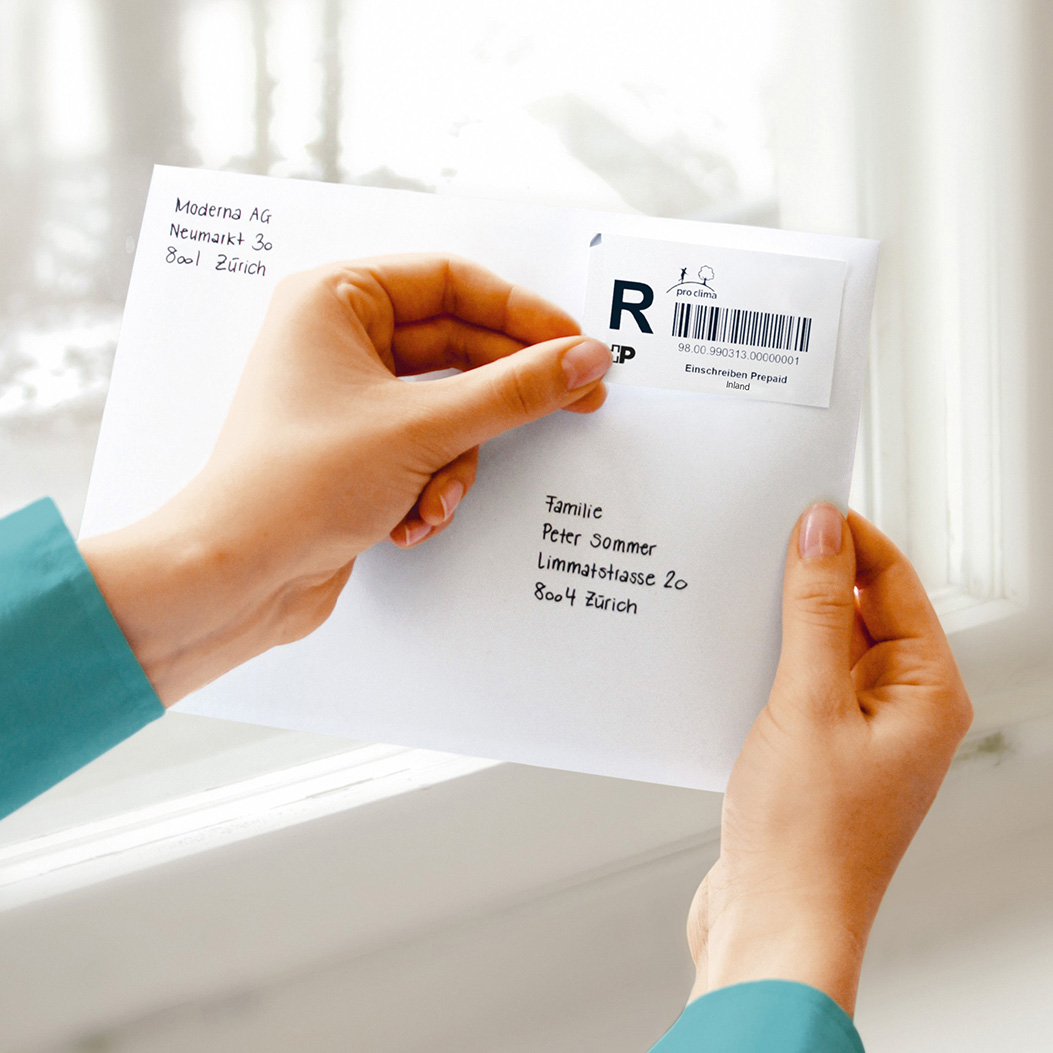
Photo credits: Post CH SA
For a letter sent abroad, write the country on the last line in capital letters, in French or English (for neighboring countries, the local language is fine), and do not put a country code such as “DE” before the postal code. For example, “NETHERLANDS”. Swiss Post’s page on international letters has the formats and prices, and a standard letter to another country can be at most 5 mm thick.
Where to buy stamps
You can buy stamps at a post office counter or in Swiss Post’s online shop. Swiss Post also lets you pay for postage online and print the stamp (“WebStamp”). If you use a digital stamp code instead of a printed stamp, write the code by hand on the envelope. Put the stamp or the code in the top-right corner.
Where to post a letter
Drop the letter in any yellow Swiss Post mailbox or hand it in at a post office counter. Each mailbox shows its last collection time. Swiss Post has moved the last collection earlier at some mailboxes, so read the time on the box and post before it. The Swiss Post location search shows the mailboxes and branches in the canton of Geneva.
How to send a registered letter in Switzerland
For official documents, contracts and anything you may need to prove you sent, use registered mail (“envoi recommandé” in French, “Einschreiben” in German). The recipient has to sign for it, or have authorized delivery without signature, and Swiss Post is liable for up to CHF 500 if it is lost or damaged. You can follow the letter online with Swiss Post’s tracking service.
You do not have to queue at a counter. If you prepare the letter yourself, with a registered label that carries a barcode, it costs the lower end of the range in the table above. You can buy the prepaid label (“Einschreiben Prepaid”) at a branch or on postshop.ch, stick it on the letter, address it and post it in a mailbox, at a My Post 24 machine or at the counter. If the branch staff frank and prepare it for you, it costs about CHF 1 more. A prepaid label cannot be combined with extras such as a return receipt or personal delivery.
Key French words in this article
Words you will use to send a letter.
- une lettre
- a letter
- une enveloppe
- an envelope
- un timbre
- a stamp
- une adresse
- an address
- le NPA
- the postal code (NPA)
- un destinataire
- a recipient
- un expéditeur
- a sender
- un envoi recommandé
- a registered mail item
- la Poste
- Swiss Post
- une boîte aux lettres
- a mailbox
- la case postale
- the P.O. box
- le courrier A, le courrier B
- A Mail, B Mail
Want to use these words with your own documents? I teach French one to one online, and the first 30 minutes are free. More information: privatefrenchgeneva.ch
Ask Samuel
Stuck on something in this article?
Send me your question and get a quick answer for CHF 50, usually within 2 hours during working hours.
Working hours are Monday to Friday, 9am to 7pm Geneva time, and I reply within one business day at most. Weekends are for urgent matters.